When data becomes everyone's responsibility, things can get messy — fast. As more teams demand faster insights, organizations are turning to self-service analytics. But giving everyone access to dashboards and data sets raises a big question: Can this model scale without compromising control, consistency, and trust?
The short answer: Yes, if done right. And it all comes down to combining freedom with structure, a strategy today’s top business intelligence service providers are beginning to master.
Self-service isn’t about replacing your data team. It’s about enabling your marketers, sales reps, and ops teams to make smart decisions without waiting on analysts. According to Gartner, by 2026, 75% of organizations will adopt some form of self-service analytics to reduce IT dependency and accelerate decisions. But with that growth comes the need for guardrails.
The Risk: Unchecked Access and Data Chaos
One of the biggest mistakes companies make is treating self-service analytics like a free-for-all. Giving everyone access to raw data without proper structure or policies is a recipe for:
- Duplicate reports and conflicting metrics
- Poor data hygiene
- Compliance issues
- Loss of trust in reporting
This is why organizations need business intelligence services that support both data democratization and governance. A strong BI foundation ensures self-service doesn’t spiral into shadow IT.
The Solution: Layered Access with Governance in Mind
The key to scaling self-service analytics isn’t about locking things down. It’s about smart layering. You grant access but clearly define the what and how through permissions, roles, and verified data sources.
Let’s look at how this works with modern BI platforms like Looker or Microsoft Power BI:
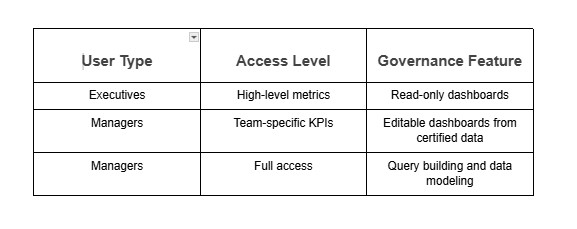
This hierarchy balances autonomy with control. Most leading business intelligence service providers now offer role-based access, audit trails, and approval flows to keep everything accountable.
Case Study: Global Manufacturer Empowering 500+ Users
A real-world example comes from Schneider Electric, which scaled self-service analytics across 40 countries and 500+ business users. With governed access and centralized data models, they cut dashboard creation time by 60%, improved trust in KPIs, and reduced IT report requests by over 45%.
The secret wasn’t just giving users access. It was training, certified data sets, and usage monitoring that made the model scalable and sustainable.
Tips to Democratize Data Without Losing Control
To make self-service analytics scalable, here are practical steps to follow:
1. Start with Certified Data Sources
Create a library of pre-approved datasets so all teams pull from the same version of truth.
2. Use Clear Role-Based Permissions
Limit what users can edit or export based on their roles. Most modern business intelligence services offer customizable permissions.
3. Train Teams on Data Literacy
A self-service model only works when users understand data context, metrics definitions, and visualization best practices.
4. Monitor Usage Patterns
Track what dashboards are accessed, by whom, and how often. This helps identify training gaps and high-impact reports.
5. Automate Governance with Metadata
Use tools like Alation or Collibra to tag, classify, and trace data lineage for better compliance and auditing.
The Role of Business Intelligence Services in Self-Service Models
Whether you're adopting Tableau, Power BI, or Looker, the role of your business intelligence service provider is critical. They're not just dashboard builders. They help create a data architecture where security, accessibility, and performance align.
A mature business intelligence service helps with:
- Centralizing your data pipelines
- Enforcing schema governance
- Building reusable dashboard components
- Providing ongoing support and training
This way, business analytics becomes not just a feature, but a culture shift.
Frequently Asked Questions
How can I ensure users don’t misuse or misinterpret self-service dashboards?
Use certified datasets, clear metric definitions, and limit editing permissions. Tools like Looker and Power BI offer strong governance options.
What’s the best way to encourage adoption without overwhelming users?
Start with small wins. Train one department at a time, provide templates, and offer quick wins through guided dashboards.
How does Ascend Analytics help scale self-service analytics?
Ascend Analytics provides business intelligence services with built-in governance frameworks, onboarding support, and scalable data models tailored to your team's needs.
Is self-service analytics only for large enterprises?
Not at all. Small to mid-size businesses benefit from it equally — especially when supported by experienced business intelligence service providers.
Can I integrate multiple tools in a self-service model?
Yes. Many organizations use hybrid stacks (e.g., Tableau + Snowflake). Just ensure your BI service supports integration and metadata consistency.
Are You Scaling Data Access the Smart Way?
Self-service analytics is no longer a trend, but rather the new normal. However, scaling it without the right controls can cause more harm than good. Partner with a business intelligence service that balances agility with governance.
Call Ascend Analytics today to design a self-service strategy that works at scale.