Data Engineering

Healthcare data foundations built for scale, trust, and action
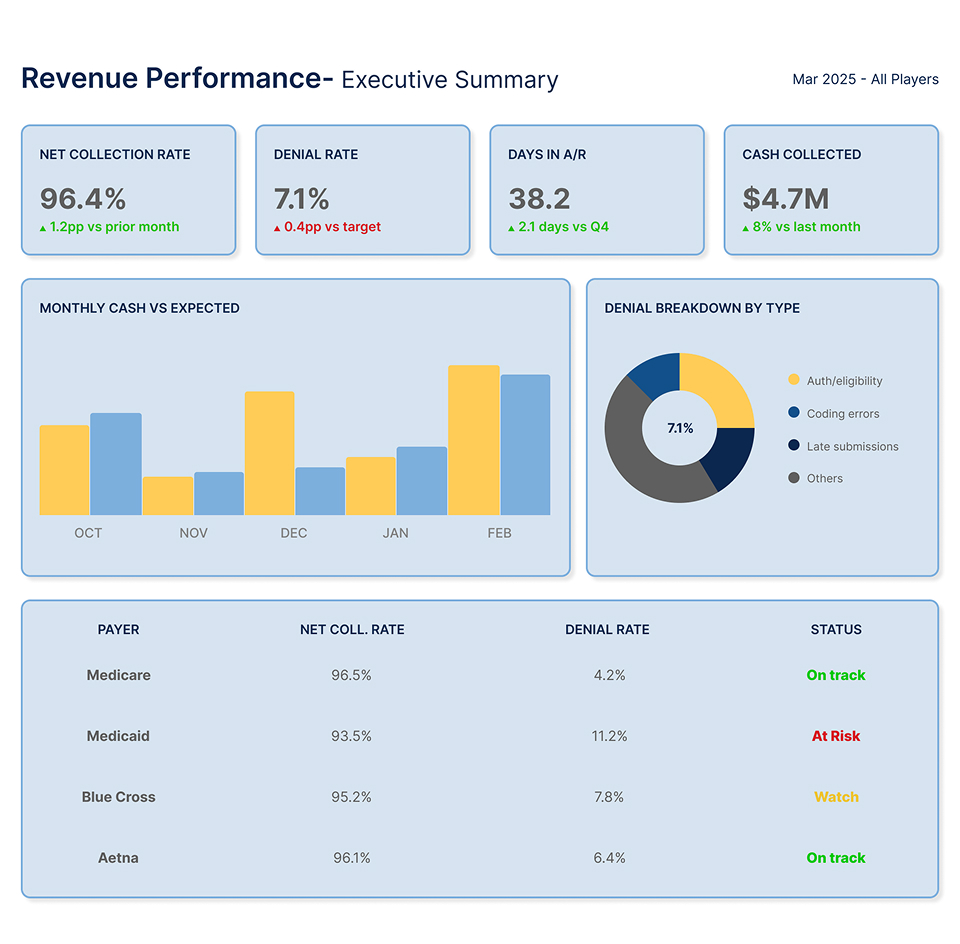
Ascend designs and delivers the data infrastructure that connects clinical, financial, and payer systems into a unified foundation so organizations can standardize performance data, enable advanced analytics, and operationalize insights without manual reconciliation.

What this enables

A single source of truth across systems

We unify clinical, financial, utilization, post-acute, and RPM data from EHRs, billing platforms, clearinghouses, and payer responses so analytics and AI operate on consistent, trusted information.

Faster analytics and automation

Well-structured pipelines and standardized layers make reporting, forecasting, and AI use cases possible without repeated engineering effort.

Data you can trace and defend

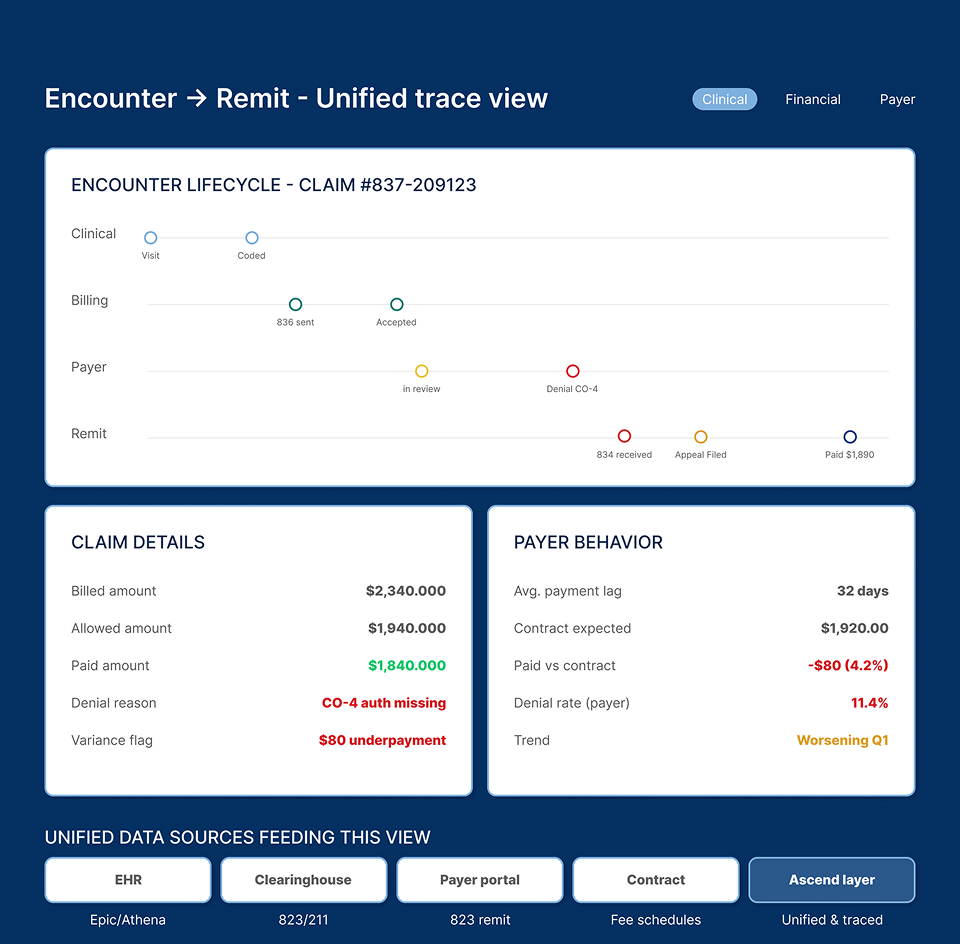
Every metric, feature, and output ties back to its source with clear logic, governance, and documentation built in.

The reality today

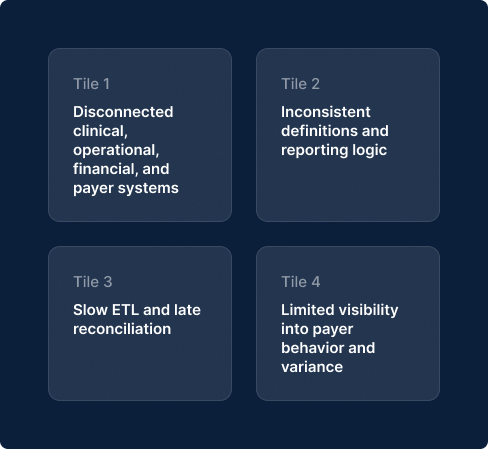
Most healthcare organizations already have powerful systems in place - Epic/Athena, claims platforms, payer portals, contract tables but the data between them doesn’t naturally align.

Clinical events, billing workflows, remittances, and payer behavior arrive in different formats, at different times, with inconsistent definitions. The result is fragmented visibility, slow reporting cycles, and limited ability to build scalable analytics on top.
What we build

Unified healthcare data layer
We ingest and normalize data from EHRs, billing platforms, clearinghouses (837/835/277), payer portals, contracts, and workqueues into a single consistent foundation.
Lakehouse architecture
We implement layered datasets - raw ingestion, standardized activity, and curated analytics-ready tables, built for scale, traceability, and reuse.
Workflow and logic mapping
We map how clinical and financial workflows actually operate so the data reflects real encounter-to-claim-to-payment behavior, not just system exports.
Quality checks that catch issues early
Automated validation routines detect gaps, mismatches, and anomalies before they become reporting fire drills or downstream model errors.
Traceable reporting and semantic consistency
Leaders can see exactly where numbers come from, with standardized definitions and metric logic that stays consistent across teams.
Built to support BI and AI
The foundation is designed for dashboards, feature stores, and model deployment, enabling advanced analytics and automation without rebuilding pipelines.
What you get is a durable healthcare data foundation that supports operational reporting, leadership visibility, and advanced use cases like opportunity detection, payer variance monitoring, and predictive analytics. Once data is unified and dependable, teams can move faster with confidence across BI, forecasting, and automation.

What we build

Step 1
Align on workflows and definitions
We start by aligning with clinical, financial, and operational leaders on the workflows, definitions, and decisions the data must support, ensuring the foundation answers real organizational questions.
Step 2
Connect and standardize
We connect the systems that drive performance and standardize how claims, remits, payer responses, and clinical context are represented so trends can be trusted across teams.
Step 3
Prove trust and enable scale
We validate accuracy, document logic clearly, and deliver an infrastructure layer built to support long-term reporting, governance, and advanced analytics.

What you get

Leadership-ready metrics and datasets
A consistent, reconciled set of core healthcare performance metrics and curated datasets that support reporting without manual stitching.
Connected visibility across clinical and financial activity
A unified view across encounters, claims, remittances, denials, adjustments, and payer behavior so teams can see both outcomes and drivers.
Definitions and logic that stay consistent
Documentation, governance, and traceability that make analytics repeatable and defensible as systems and teams evolve.

Visual module

Turn fragmented healthcare data into a dependable foundation.

Get a free consult on your data architecture